How to Improve Your Badminton Smash Power: It's Not About Strength
Watch a 140-pound professional smash at 350 km/h, then watch a 200-pound beginner struggle to hit 200 km/h. The difference? Technique, not muscle mass.
Most players trying to improve smash power make the same mistake: they swing harder with their arm. This actually reduces power AND increases injury risk. A proper smash uses your entire body in a coordinated chain—legs, core, shoulder rotation, and finally wrist snap.
This guide breaks down the exact mechanics of a powerful smash and gives you specific drills to increase your speed safely.
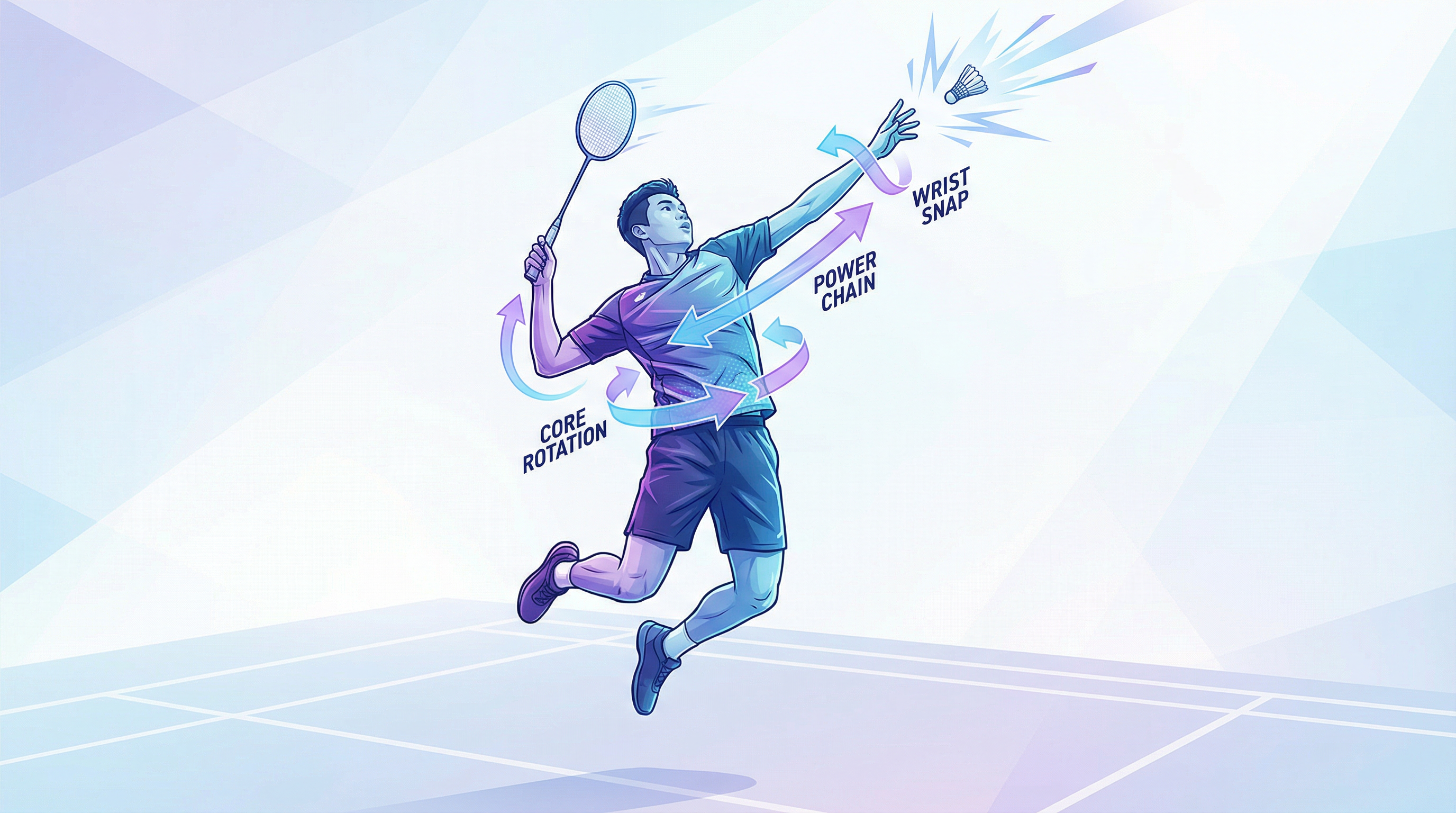
The Power Chain: Where Smash Power Actually Comes From
A badminton smash generates power from the ground up, not from your arm. Here is the sequence:
- Jump: Legs explode upward, creating upward momentum
- Hip rotation: Hips rotate from side-facing to front-facing
- Core rotation: Torso follows hips, winding up like a spring
- Shoulder rotation: Hitting shoulder rotates backward then forward
- Elbow extension: Arm extends from bent to straight
- Forearm pronation: Forearm rotates inward rapidly
- Wrist snap: Final acceleration through wrist flexion
If any link in this chain is weak or mistimed, you lose power. Most beginners skip steps 1-4 and go straight to step 7, wondering why their smash is weak.
The 5 Technical Fixes That Add Instant Power
Fix #1: Hit the Shuttle at Peak Height
Timing beats strength. Hitting the shuttle 6 inches higher adds more power than swinging 20% harder. Why? Gravity helps accelerate your racket downward, and you hit at a steeper angle.
How to practice: Set up a shuttle on a string at maximum reach height. Practice jumping and making contact at the absolute peak of your jump. Film yourself from the side—most beginners hit on the way down, not at the top.
Fix #2: Rotate Your Body, Not Just Your Arm
Stand side-facing (left shoulder toward net for right-handers). As you smash, your chest should rotate from side-facing to fully front-facing. This rotation adds 30-40% more power than arm-only swings.
How to practice: Shadow smashes in slow motion. Focus on starting side-facing and finishing chest-facing. Feel your hips lead the rotation, then shoulders, then arm follows.
Fix #3: Use Forearm Pronation (The Secret Weapon)
Pronation is rotating your forearm so your palm goes from facing up to facing down. This is where racket head speed comes from. Watch pros in slow motion—their forearm rotates rapidly just before contact.
How to practice: Hold your racket with arm extended overhead. Rotate your forearm back and forth: palm up, palm down, palm up, palm down. Do this 20 times daily. Then practice hitting with just forearm rotation—no shoulder, no body. You will be surprised how much power comes from this alone.
Fix #4: Snap Your Wrist at Contact
The wrist snap happens AFTER pronation, not instead of it. Your wrist should be relaxed during the swing, then snap forward at the instant of contact.
How to practice: Stand close to the net. Drop a shuttle and hit it straight down into the ground using only wrist snap. Hear that crack sound? That is what you want at full-speed smashes.
Fix #5: Follow Through Fully
Your racket should finish near your opposite hip, not stop at your shoulder. Full follow-through transfers maximum energy to the shuttle and protects your shoulder from deceleration injuries.
The Perfect Smash Checklist:
- ✓ Start side-facing, jump upward
- ✓ Reach maximum height before contact
- ✓ Rotate hips and chest toward net
- ✓ Pronate forearm rapidly
- ✓ Snap wrist at contact point
- ✓ Follow through to opposite hip
The Most Common Power-Killing Mistakes
Mistake #1: Muscling the Shot
Tensing your arm during the swing slows down racket speed. Power comes from speed, not force. Stay relaxed until the moment of contact, then explode.
Mistake #2: Hitting Too Early
Contacting the shuttle in front of your body (not overhead) reduces your power by 50%+. You cannot use body rotation or wrist snap effectively from this position.
Mistake #3: Gripping Too Tight
A death grip on your racket prevents wrist snap and pronation. Hold with 40% grip strength during the swing, then squeeze to 80% at contact.
Mistake #4: Landing Before Hitting
If you land before making contact, you are jumping too early. Time your jump so contact happens at the peak, THEN you land.
Training Drills to Build Smash Power
Drill 1: Wall Smashes (Wrist Strengthening)
Stand 2 feet from a wall. Smash a shuttle into the wall using only wrist and forearm. No body rotation allowed. Do 3 sets of 10 reps. This isolates and strengthens the wrist snap.
Drill 2: Medicine Ball Overhead Throws
Hold a 2-4 kg medicine ball. Throw it overhead as hard as you can, mimicking smash motion. This builds explosive power in the same muscle chain as badminton smashes. Do 3 sets of 8 throws.
Drill 3: Resistance Band Smashes
Attach a resistance band to your racket handle. Practice smash motion against resistance. This strengthens the exact muscles used during smashes. Do 3 sets of 15 reps.
Drill 4: Multi-Shuttle Smashing
Have a partner feed you shuttles continuously for 30 seconds. Focus on technique, not power. High-volume repetition ingrains proper mechanics. Rest 90 seconds, repeat 5 times.
Does Your Racket Matter?
Yes, but less than you think. A head-heavy, stiff racket adds about 10-15% more smash power compared to a head-light, flexible racket. But perfect technique with a cheap racket beats terrible technique with a $300 racket.
If you are smashing under 250 km/h, your issue is technique, not equipment. Fix your mechanics first. Once you are smashing 300+ km/h consistently, then consider upgrading to a power-focused racket.
String Tension and Smash Power
Lower tension (22-24 lbs) creates a trampoline effect that adds power—good for beginners. Higher tension (26-28 lbs) gives more control but requires better technique to generate power.
If your technique is still developing, use lower tension. Once you master the mechanics, gradually increase tension for better placement control. See our string tension guide for details.
Strength Training for Smash Power
While technique is king, specific strength training helps. Focus on:
- Core rotational exercises: Cable woodchops, Russian twists (3 sets of 12 reps)
- Shoulder stability: Face pulls, external rotations (3 sets of 15 reps)
- Leg explosiveness: Box jumps, jump squats (3 sets of 8 reps)
- Wrist strength: Wrist curls with light weights (3 sets of 20 reps)
Train these 2-3 times per week. You will see smash power gains within 4-6 weeks.
How Fast Should Your Smash Be?
Here are realistic smash speed benchmarks:
- Beginner (first 6 months): 180-220 km/h
- Intermediate (1-2 years): 240-280 km/h
- Advanced club player: 290-330 km/h
- Professional: 350-400+ km/h
Most players hit plateaus around 260-280 km/h. Breaking through requires addressing specific technical flaws, usually with video analysis or coaching.
The 30-Day Smash Power Challenge
Week 1-2: Technique Focus
Film your smash from the side. Compare to pro videos. Identify your biggest flaw (timing, rotation, wrist snap). Practice that ONE element in isolation for 10 minutes daily.
Week 3-4: Volume Training
Smash 100 shuttles per session, 3 times per week. Focus: maintain perfect technique even when tired. Speed comes from repetition with correct form.
Week 5+: Strength Integration
Add medicine ball throws and resistance band work 2x per week. Continue high-volume smashing with technique focus.
Expected result: 15-25 km/h increase in smash speed within 30 days if you follow this consistently.
Final Thoughts
Power is built, not born. You do not need to be 6 feet tall or have massive shoulders to smash hard. The 5'6" player with perfect technique will out-smash the 6'2" player with poor mechanics every time.
Focus on the fundamentals: timing, rotation, pronation, wrist snap. Film yourself, compare to pros, fix one flaw at a time. Consistency beats intensity—practicing correct technique 3 times per week beats sporadic intense sessions.
Your smash power will improve. It just takes patience and attention to detail.
Related Guides
Improve your overall game with our guides on racket flexibility, solo practice drills, and proper warm-up techniques to prevent injury during power training.