Court Shoes vs Running Shoes: Why It Actually Matters for Badminton
Showed up to my first club session in Nike running shoes. Everyone else had proper court shoes, but I figured shoes are shoes, right?
Twenty minutes in, I lunged sideways for a drop shot. My ankle rolled completely sideways. Heard a pop. Couldn't put weight on it.
Sprained ankle. Out for 3 weeks. Had to hobble around campus on crutches. All because I wore the wrong shoes.
Running shoes and court shoes look similar. They're engineered for opposite movements. Here's why that matters way more than I thought.
The Core Design Difference
Running shoes and badminton shoes are engineered for opposite movement patterns. Understanding this distinction clarifies why one doesn't substitute for the other.
Running Shoes: Forward Motion Design
Running shoes optimize for heel-to-toe forward propulsion. The design features include:
- Elevated heel cushioning: Absorbs impact from forward heel strikes
- Curved sole (rocker design): Promotes forward rolling motion
- Flexible midfoot: Allows natural foot flex during push-off
- Soft, thick midsole: Maximizes shock absorption for repetitive forward impact
- Grooved outsole: Provides traction for straight-line movement
These features work excellently for jogging, distance running, and treadmill use. They're completely wrong for badminton.
Badminton Court Shoes: Lateral Stability Design
Badminton shoes prioritize side-to-side stability and quick pivots. The design features include:
- Flat, low-profile sole: Provides stability during lateral lunges
- Reinforced sidewalls: Prevents ankle rolling during side movements
- Firm midsole: Maintains court feel and prevents excessive flex
- Gum rubber outsole: Grips polished court surfaces without marking
- Toe and medial reinforcement: Protects against drag and wear from pivots
Every design element addresses the specific stresses of badminton movement: explosive lunges, rapid direction changes, and constant lateral shifts.
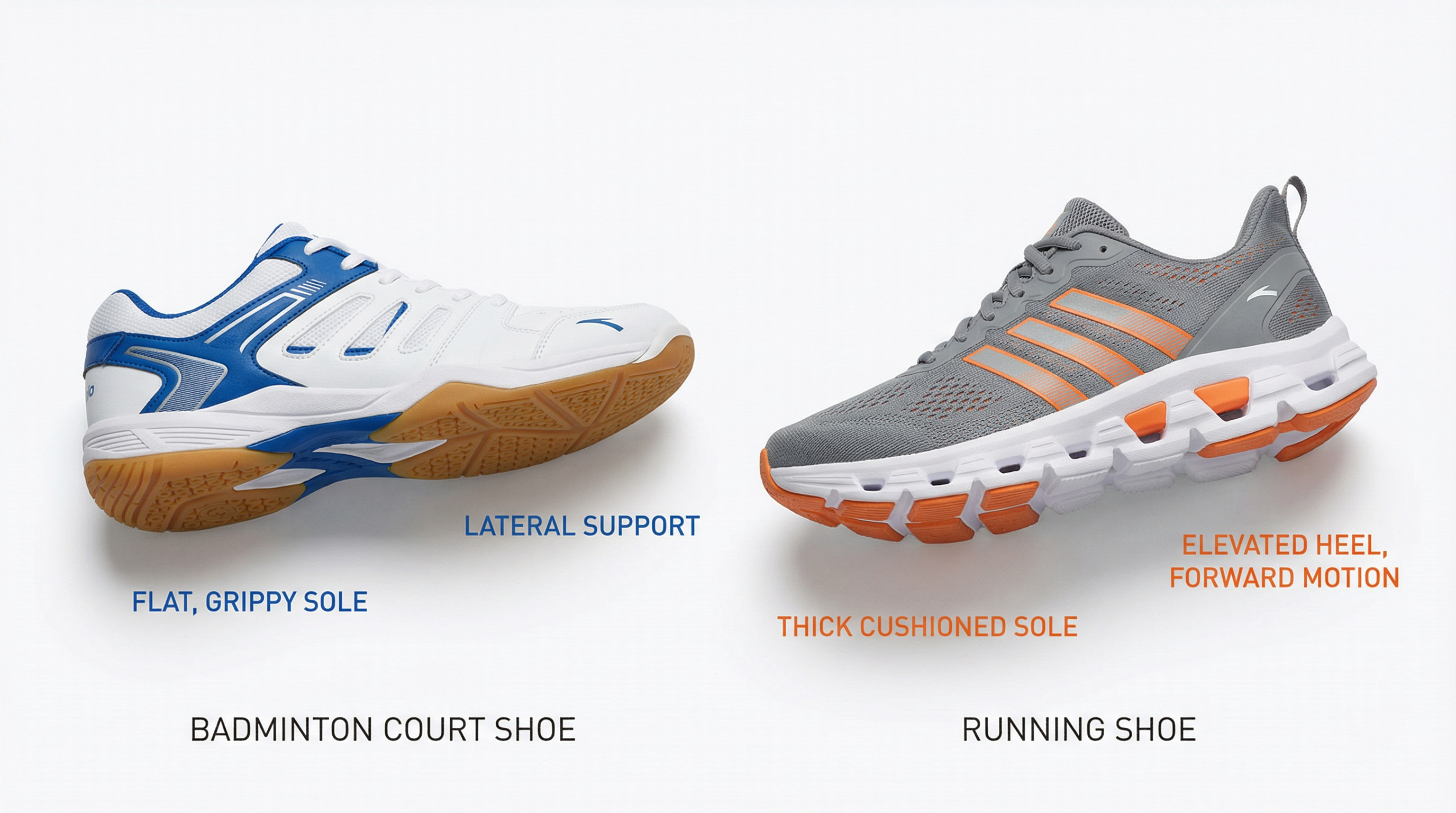
Detailed Comparison
| Feature | Running Shoes | Badminton Court Shoes |
|---|---|---|
| Heel Height | Elevated (10-12mm+ drop) | Flat (0-6mm drop) |
| Sole Shape | Curved rocker design | Flat, stable base |
| Lateral Support | Minimal (not needed for running) | Reinforced sidewalls and structure |
| Cushioning | Soft, thick (max shock absorption) | Firm, responsive (court feel) |
| Outsole Material | Hard rubber or EVA foam | Gum rubber (non-marking) |
| Tread Pattern | Deep grooves for forward grip | Multidirectional for pivots |
| Flexibility | Flexible forefoot for toe-off | Stiff for stability during lunges |
| Weight | Varies (250-350g) | Lightweight (270-320g) |
| Toe Protection | Minimal | Reinforced for toe drag |
Why These Differences Cause Injuries
1. Ankle Sprains from Lack of Lateral Support
Badminton involves constant side-to-side lunging. When you lunge sideways in running shoes, the elevated heel and flexible structure allow your ankle to roll inward or outward beyond its safe range of motion.
What happens: The soft midsole compresses unevenly under lateral force, providing no resistance as your ankle rolls. Court shoes use firm sidewalls and structured support to prevent this dangerous motion.
Injury risk: Ankle sprains are the most common badminton injury, accounting for approximately 40% of all court injuries. Improper footwear dramatically increases this risk.
2. Knee Stress from Unstable Base
The curved sole of running shoes creates an unstable platform during lateral movement. Your knee compensates by working harder to stabilize your body during direction changes.
What happens: Instead of your foot providing a stable base, your knee absorbs rotational forces it wasn't designed to handle. This leads to meniscus stress, ligament strain, and patellar tracking issues.
Injury risk: Chronic knee pain develops gradually over weeks or months, often not connecting to footwear until damage is already present.
3. Reduced Reaction Time from Excess Cushioning
Thick, soft cushioning in running shoes delays force transfer between your body and the court. This creates a fraction-of-a-second lag in response time during quick movements.
What happens: When you try to push off for a fast return, your foot sinks into the cushioning before force transfers to the court. Court shoes use firmer midsoles that provide immediate response.
Performance impact: While not directly an injury, delayed reactions force you into awkward positions and off-balance recoveries, which increase injury likelihood.
4. Slipping on Polished Courts
Running shoe outsoles use harder rubber compounds optimized for pavement grip. On polished wooden or synthetic courts, these materials don't provide adequate traction.
What happens: Your foot slips during push-off or direction changes, forcing you into splits-like positions or causing falls. Gum rubber court shoe outsoles grip polished surfaces reliably.
Injury risk: Sudden slips can cause groin strains, hamstring pulls, and impact injuries from falls.
⚠️ Real Injury Statistics
Studies of recreational badminton players show that those using non-court-specific footwear experience:
- 2.5x higher rate of ankle sprains
- Significantly more knee pain complaints
- Higher incidence of Achilles tendon stress
- More frequent falls and loss of balance incidents
These aren't hypothetical risks — they're documented outcomes from using inappropriate footwear.
When Running Shoes Are Acceptable (Temporarily)
There are limited situations where running shoes won't immediately cause harm:
Very First Session (Trying Badminton)
If you're testing badminton for the first time in a single casual session, running shoes are acceptable temporarily. You'll be moving slowly, learning basic strokes, and not performing explosive movements yet.
Timeline: One or two introductory sessions only. If you decide to continue playing, proper shoes become essential.
Low-Intensity Practice (Movement Drills)
Light footwork practice without shuttles — shadow movements at walking pace — doesn't create the forces that cause injury. Even here, court shoes are better, but the immediate risk is minimal.
Timeline: Short-term only. Regular practice with any intensity requires proper footwear.
💡 Honest Assessment
If you're playing more than 2-3 times total, proper court shoes aren't optional anymore. The $40-80 investment prevents injuries that cost far more in medical bills, lost playing time, and potential chronic issues.
Many recreational players rationalize using running shoes to "save money" while spending more on rackets or shuttles. Shoes matter more than either for injury prevention.
What About Other Shoe Types?
Tennis Shoes
Tennis shoes are closer to badminton shoes than running shoes, featuring lateral support and flat soles. However, they're typically heavier and designed for outdoor courts with different surface characteristics.
Acceptability: Better than running shoes, acceptable for recreational play. Not ideal for regular players due to weight and grip differences.
Basketball Shoes
Basketball shoes provide excellent lateral support and non-marking soles. The main issue is weight — most basketball shoes are significantly heavier than badminton shoes, causing faster fatigue.
Acceptability: Safe for injury prevention but suboptimal for performance. Usable if you already own them, but dedicated court shoes are better long-term.
Volleyball Shoes
Volleyball shoes are very similar to badminton shoes in design — lightweight, flat sole, lateral support, gum rubber outsole. They work well for badminton.
Acceptability: Excellent alternative. Often slightly cheaper than badminton-specific shoes while providing equivalent safety and performance.
Cross-Training Shoes
Cross-trainers attempt to blend running and lateral movement features. This compromise results in shoes that don't excel at either purpose.
Acceptability: Better than pure running shoes, worse than court-specific options. Temporary solution at best.
Choosing Proper Badminton Shoes
Once you've decided proper footwear matters (ideally before your third session), here's what to prioritize:
Essential Features
- Non-marking gum rubber outsole: Required by most clubs and facilities
- Lateral ankle support: Reinforced sidewalls or structured upper
- Flat, low-profile design: Minimal heel-to-toe drop (under 6mm)
- Lightweight construction: Under 320g to prevent fatigue
- Breathable upper: Prevents overheating during long sessions
Budget Options That Work
You don't need $150 flagship models. Entry-level court shoes ($40-70) from Yonex, Victor, Li-Ning, or Asics provide all essential safety features.
The difference between budget and premium models is mostly cushioning technology, weight optimization, and materials — not fundamental safety design.
Fit Matters More Than Brand
A well-fitting $50 shoe protects better than a poorly-fitting $120 shoe. Prioritize:
- Snug heel that doesn't slip during movement
- Toe box with slight room (about thumb-width from longest toe)
- No pressure points or rubbing during lateral movement
- Comfortable width through the midfoot
💡 Break-In Expectations
Court shoes should feel comfortable immediately with minimal break-in needed. If shoes cause pain or pressure during the first try-on, they're the wrong fit — breaking them in won't fix structural mismatch.
Proper court shoes feel noticeably different from running shoes: flatter, firmer underfoot, and more supportive around the ankle.
Where to Buy Court Shoes
If you've determined proper footwear is necessary (and if you're playing regularly, it is), here are purchase options:
Badminton shoes prevent injuries that cost far more than the shoes themselves. This is safety equipment, not optional gear.
General Court Shoes:
Browse Badminton Shoes Yonex Court Shoes Victor Court ShoesCommon Questions
"Can I Just Play Carefully in Running Shoes?"
Playing "carefully" means avoiding the lateral lunges, quick pivots, and explosive movements that define badminton. You'll be restricting your movement to prevent injury, which prevents you from actually playing the sport.
Additionally, many injuries occur during instinctive reactions — you can't consciously control your response when a shuttle comes at you unexpectedly.
"I've Been Using Running Shoes With No Issues"
Absence of injury so far doesn't mean absence of risk. Many chronic issues develop gradually without acute pain signals until damage accumulates.
Additionally, as your skill improves and you move faster with more intensity, the injury risk increases significantly. What worked during slow beginner play becomes dangerous during intermediate-level rallies.
"What If My Club Doesn't Require Court Shoes?"
Facility rules about non-marking soles protect the court surface, not your ankles. Just because a club allows running shoes doesn't mean they're safe — it means the club prioritizes floor protection over enforcing player safety equipment.
Your injury risk remains the same regardless of club rules.
⚠️ Insurance and Liability Note
Some sports injury insurance policies specifically exclude coverage for injuries sustained while using inappropriate equipment for an activity. Playing badminton in running shoes may technically void coverage in some cases.
More importantly: dealing with a sprained ankle, torn ligament, or chronic knee issue costs far more than $60 court shoes in medical bills, lost work time, and playing interruption.
Final Recommendation
If you're playing badminton more than 2-3 casual sessions total, proper court shoes are essential safety equipment, not optional gear or performance enhancement.
Running shoes aren't a budget-friendly alternative — they're equipment designed for completely different biomechanics that increase injury risk during lateral movement sports.
Budget court shoes ($40-70) from any reputable badminton brand provide adequate protection. You don't need premium models, but you do need court-specific design features: flat sole, lateral support, and gum rubber grip.
The choice isn't between expensive shoes or running shoes. It's between appropriate safety equipment or significantly increased injury risk that interrupts your playing and costs more to treat than shoes cost to prevent.
If you're still using running shoes after reading this: you now understand the specific risks you're accepting. Make that decision consciously, not out of assumption that "shoes don't really matter."