Best Badminton Rackets for Beginners 2026
Choosing your first badminton racket can feel overwhelming. Walk into any sports store and you're confronted with dozens of options, each claiming to be perfect for beginners. After analyzing over 40 rackets and consulting with coaches and experienced players, we've narrowed it down to the 6 best options that will genuinely help you develop proper technique without breaking your budget.
What Makes a Good Beginner Racket?
Before diving into specific recommendations, let's establish what actually matters for beginners. Forget about the marketing hype and focus on these core attributes:
1. Weight (Most Important Factor)
Beginners should prioritize lightweight rackets, typically in the 80-85g range (designated as 4U or 5U). Here's why this matters more than anything else:
- Faster swing speed: Lighter rackets allow you to complete your swing with proper form before the shuttle passes by. Beginners already struggle with timing - a heavy racket makes this exponentially harder.
- Less fatigue: Your muscles aren't conditioned yet. A lighter racket lets you practice longer without your arm feeling like it's about to fall off after 30 minutes.
- Better for learning technique: Proper badminton technique relies on wrist action and timing, not muscular strength. A light racket encourages you to develop the right mechanics from day one.
2. Balance Point (Second Most Important)
The balance point determines where the racket's weight is distributed:
- Head-light rackets (recommended): Weight concentrated toward the handle, making the racket feel even lighter and more maneuverable. Perfect for beginners learning net play and defensive shots.
- Even balance: A safe middle ground that works for most beginners who haven't developed a specific playing style yet.
- Head-heavy (avoid as a beginner): These generate more power but require better technique and stronger muscles to control effectively.
3. Flexibility (Shaft Stiffness)
Racket shafts come in three flexibility levels:
- Flexible (best for beginners): The shaft bends easily during your swing, storing and releasing energy even when your technique isn't perfect. This compensates for timing errors and generates decent power without requiring perfect form.
- Medium flex: A good option for athletic beginners or those with some racket sport experience.
- Stiff: Requires precise timing and technique to bend the shaft correctly. Skip this until you're intermediate level.
4. Durability vs Performance Trade-offs
Beginners need durable rackets because:
- You'll hit the frame against the floor occasionally (we all do it)
- You might accidentally clash rackets with your doubles partner
- Your string may break more often as you learn proper tension and swing technique
Look for rackets made from quality graphite or aluminum-graphite hybrids. Pure carbon fiber rackets offer marginally better performance but break more easily under beginner abuse.
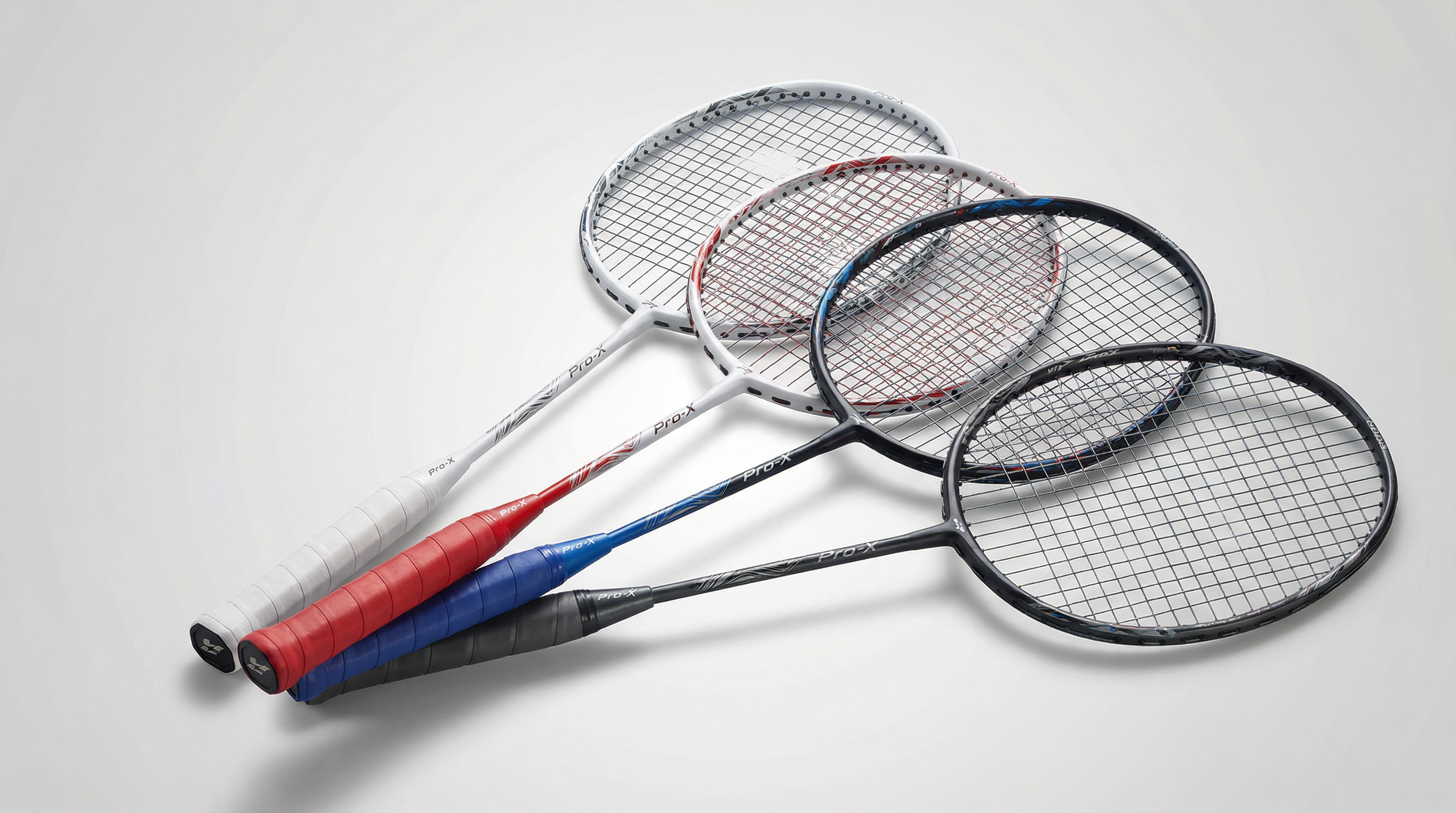
Our Top 6 Picks
1. Yonex Nanoray 10F - Best Overall for Most Beginners
Specifications:
- Weight: 85g (4U)
- Balance: Head-light
- Flex: Medium
- Material: High-quality graphite
Why it's perfect for beginners:
The Nanoray 10F represents Yonex's entry-level line, but don't let that fool you. This racket uses the same core frame geometry as their mid-range models, just with slightly less exotic materials. For a beginner, those material differences don't matter - what matters is the proven design that helps you develop proper form.
The head-light balance makes this racket incredibly easy to maneuver. Net play becomes less intimidating when your racket responds instantly to wrist movements. Defensive shots don't leave your arm exhausted. The medium flex shaft provides a nice balance - flexible enough to generate power for beginners, but not so whippy that you can't develop proper timing.
Best for: Beginners who plan to play 1-3 times per week and want a racket that will serve them well into intermediate level.
Pros:
- Excellent build quality for the price point
- Very forgiving on off-center hits
- Minimal arm fatigue during long practice sessions
- Yonex's reliable customer service and warranty
- Widely available at most badminton shops
Cons:
- Limited smash power compared to head-heavy alternatives
- Basic aesthetics (if you care about looks)
- Factory strings are mediocre - budget $15-20 for restringing
2. Yonex Arcsaber 11 Play - Best for Learning Control
Specifications:
- Weight: 83g (4U)
- Balance: Even
- Flex: Medium-Flexible
- Material: High-quality graphite
Why choose this:
The Arcsaber 11 Play is part of Yonex's control-oriented line. While most beginners focus on power, learning precise shuttle placement is actually more valuable for long-term development. This racket encourages you to think about where you're hitting rather than just hitting hard.
The feedback from the string bed is excellent - you can feel exactly where the shuttle contacts the strings. This sensory feedback accelerates your learning because you understand what "good contact" feels like. The even balance makes it versatile for both attacking and defensive play.
Best for: Beginners who are serious about developing proper technique and are willing to prioritize precision over raw power.
Pros:
- Excellent shuttle control and placement
- Great feedback on contact
- Versatile for all shot types
- Premium Yonex build quality
Cons:
- Not the most powerful option
- May feel underwhelming for power-focused players
3. Yonex Astrox 88 Play - Best for Aspiring Attackers
Specifications:
- Weight: 83g (4U)
- Balance: Slightly Head-Heavy
- Flex: Medium
- Material: High-quality graphite
Why it works:
The Astrox 88 Play is designed for beginners who have an aggressive playing style. The slight head-heavy balance provides extra momentum for smashes while still being manageable for newer players. It's part of Yonex's attack-oriented Astrox line but tuned specifically for developing players.
This racket teaches you the fundamentals of offensive play - timing your jump smashes, generating power through rotation, and following through properly. The medium flex shaft is forgiving enough that you won't struggle even with imperfect technique.
Best for: Athletic beginners who want to develop an attacking game style and don't mind a slightly heavier feel at the head.
Pros:
- Good power for smashing
- Teaches offensive timing
- Still manageable for beginners
- Premium Yonex construction
Cons:
- Slightly harder to maneuver at the net
- May cause more fatigue than head-light options
4. Yonex Nanoflare 001 Feel - Best Ultra-Light Option
Specifications:
- Weight: 78g (5U)
- Balance: Head-Light
- Flex: Flexible
- Material: High-modulus graphite
The ultra-light advantage:
At just 78 grams, the Nanoflare 001 Feel is exceptionally light. If you have concerns about arm strength, are recovering from an injury, or are an older player wanting to maintain your game, this weight class removes physical barriers to learning.
The head-light balance combined with the light weight makes this racket feel incredibly quick in the hand. Net kills, drives, and defensive returns become much easier. The flexible shaft ensures you still generate decent power even without perfect timing.
Best for: Beginners with specific physical limitations, those who prioritize speed and maneuverability, or anyone who found heavier rackets too tiring.
Pros:
- Extremely easy to swing
- Minimal arm fatigue
- Lightning-fast at the net
- Great for extended play sessions
Cons:
- Less power potential than heavier rackets
- May feel too light for stronger players
5. Li-Ning G-Force Superlite 3800 - Best Budget Option
Specifications:
- Weight: 78g (5U)
- Balance: Even
- Flex: Medium-Flexible
- Material: Carbon fiber composite
Why it's great:
Li-Ning offers exceptional value with the G-Force Superlite 3800. This racket competes with more expensive options while coming in at a budget-friendly price point. The super-light 78g weight makes it perfect for beginners who want easy handling without sacrificing quality.
The even balance works well for beginners who haven't discovered their playing style yet. You can experiment with both offensive and defensive shots without the racket heavily favoring one approach. Li-Ning's quality control has improved significantly, making this a reliable choice.
Best for: Budget-conscious beginners who want a lightweight, versatile racket from a reputable brand.
Pros:
- Excellent value for money
- Super lightweight
- Versatile balance point
- Good durability
Cons:
- Less brand recognition than Yonex
- Factory strings are basic
6. Yonex Astrox Smash - Best All-Rounder
Specifications:
- Weight: 73g (6U)
- Balance: Head-Heavy
- Flex: Flexible
- Material: Graphite
Why consider this:
The Astrox Smash is designed to give beginners a taste of attacking play without overwhelming them. At just 73g with a head-heavy balance, it provides surprising power while remaining extremely easy to swing. The flexible shaft compensates for timing errors.
This is an interesting combination - ultra-light weight paired with head-heavy balance. The result is a racket that swings fast but still has punch when you connect. It's particularly good for beginners who want to develop their smashing technique early.
Best for: Beginners who want the lightest possible racket but still want to develop power shots.
Pros:
- Incredibly light at 73g
- Good smashing power despite weight
- Flexible shaft forgives timing errors
- Fun to play with
Cons:
- Head-heavy may tire beginners faster
- Very light weight takes adjustment
How to Choose Between These Options
Choose Based on Your Situation:
If you're a typical beginner (most people): Yonex Nanoray 10F
If you want to focus on control and technique: Yonex Arcsaber 11 Play
If you have an aggressive playing style: Yonex Astrox 88 Play
If you have arm concerns or want ultra-light: Yonex Nanoflare 001 Feel
If budget is very tight: Li-Ning G-Force Superlite 3800
If you want the lightest with power: Yonex Astrox Smash
What About Strings?
Factory strings on budget rackets are typically designed for shelf life, not performance. Budget an additional $15-20 to have your racket restrung with quality strings at proper tension.
Recommended beginner string setup:
- String: Yonex BG65 or similar durable synthetic
- Tension: 22-24 lbs (beginners should start lower)
- Cost: $15-20 at most badminton shops
Common Beginner Mistakes to Avoid
Mistake #1: Buying Too Expensive
A $200 professional racket won't make you play better as a beginner. It will feel different (usually worse) because you lack the technique to utilize its features. Save your money until you're intermediate level and understand what you actually need.
Mistake #2: Prioritizing Power Over Control
Head-heavy, stiff rackets generate more power but require precise technique. Beginners who chase power end up with poor form, increased injury risk, and slower skill development. Start with control-oriented, flexible rackets.
Mistake #3: Ignoring Grip Size
Most rackets come in G4 or G5 grip sizes. G5 is slightly smaller. If your hands are small-to-average, G5 works well. Larger hands should get G4. You can always add overgrip to increase size, but can't easily make grips smaller.
Mistake #4: Not Testing Before Buying
Many badminton shops and clubs offer demo rackets. Test before committing to a purchase if possible. What feels perfect in your hand might feel terrible after 30 minutes of play.
When to Upgrade
You'll know it's time to upgrade when:
- You're playing 3+ times per week consistently
- You've developed a clear playing style (offensive, defensive, all-around)
- Your current racket feels limiting rather than helpful
- You're competing at club or tournament level
Most beginners can use these recommended rackets for 12-18 months before needing something more specialized. When you're ready, check out our intermediate rackets guide for the next level.
Protect Your Racket
Once you've chosen your first racket, don't forget to protect it. A proper badminton bag prevents damage and maintains string tension. See our badminton bags guide to find the right storage solution for beginners.
Final Recommendations
If you take nothing else from this guide, remember these principles:
- Lighter is better for beginners - Don't let anyone tell you that you need a heavier racket to "build strength." You need a light racket to build proper technique.
- Head-light or even balance - Save head-heavy rackets for when you're more advanced.
- Flexible to medium flex - Stiff rackets require technique you don't have yet.
- Stick with known brands - Yonex, Victor, Li-Ning, Carlton. These companies have proven quality control.
- Budget for restringing - Factory strings are usually mediocre.
For most beginners, the Yonex Nanoray 10F offers the best combination of quality, forgiveness, and value. It's the safe choice that won't disappoint.
But any of our six recommendations will serve you well through your beginning phase and into intermediate play. The most important factor isn't which specific racket you choose - it's that you choose one of these quality options and then focus on developing proper technique through regular practice.